
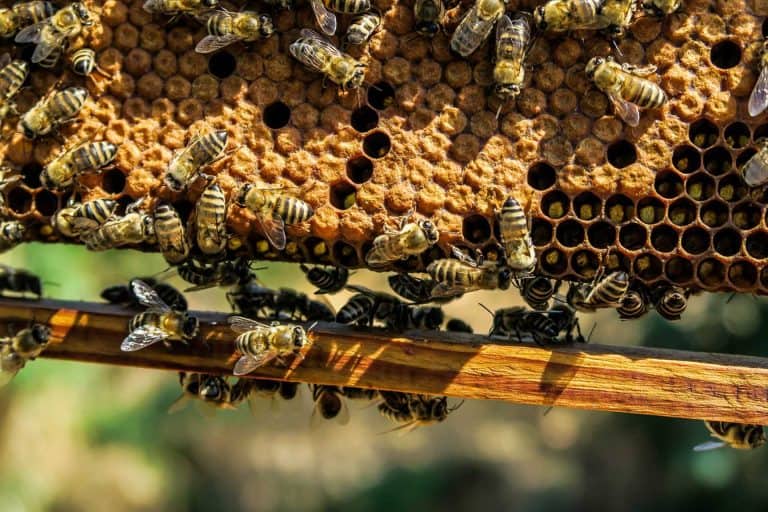
For several years, a beekeeper in Goma has been sounding the alarm over the worrying decline in honey production, which he attributes to the establishment of local beverage manufacturing plants that fail to comply with environmental standards. For nearly a decade, HABYARIMANA NERIGIMANA Isaac, better known as “Mzee wa Nyuki Isaac,” has devoted himself to beekeeping in Goma, in North Kivu province. Now in his fifties, he has been practicing this trade since 2015.

Through beekeeping, he says, he was able to provide for his family and educate his children, two of whom have completed university, while the youngest is still in secondary school. Today, however, the beekeeper says he is deeply concerned by the drastic drop in his honey production.
According to him, current production is in no way comparable to that of previous years. “When I started this work, I produced a lot of honey. I was proud of my activity. I paid my children’s school fees without difficulty and covered other family expenses,” he recalls.
Today, his beehives are gradually emptying. He attributes this situation to the installation, in several neighborhoods of Goma, of local beverage factories, particularly those producing Kargazok, a drink made from water and sugar.
“At a certain point, large entrepreneurs came to set up Kargazok production factories in our neighborhood without respecting environmental standards,” complains Mzee wa Nyuki Isaac.
He explains that the high sugar content of this beverage strongly attracts bees. “Bees like sugary water. They head toward the large tanks containing this drink to feed. Many fall into these uncovered tanks and die,” he says.
According to the beekeeper, the lack of protective measures around these facilities is the main problem. “The tanks are not covered. The owners of these companies take no steps to prevent bees from landing there,” he laments.
Mzee wa Nyuki Isaac says he has directly witnessed this alarming phenomenon. Attracted by sugar, the bees leave their hives and head toward the industrial installations.
“My hives are almost empty today. I tried to report this to the authorities, but unfortunately, since these companies pay a lot of taxes to the state, my complaints are often ignored,” he regrets. He says he no longer knows whom to turn to, while helplessly watching the gradual disappearance of his bees.
This situation has direct consequences on his living conditions. “I can no longer meet my basic needs,” he confides.

The beekeeper speaks openly of a real “massacre” of a species that is essential to both humans and the environment. “Bees play a fundamental role in pollination and in maintaining ecological balance. Their disappearance threatens not only our activity, but also agriculture and biodiversity,” he warns.
According to his observations, these factories lack adequate facilities and sufficient protective mechanisms to prevent insects from accessing dangerous areas, a situation he considers environmentally irresponsible.
Faced with what he considers an ecological emergency, HABYARIMANA NERIGIMANA Isaac calls on the relevant authorities to take action. He urges the enforcement of strict environmental standards for local companies, both during their establishment and throughout their operations.
“Industrial development must not come at the expense of the environment or of the species that sustain human life,” he concludes.
By Fiston MUHINDO